

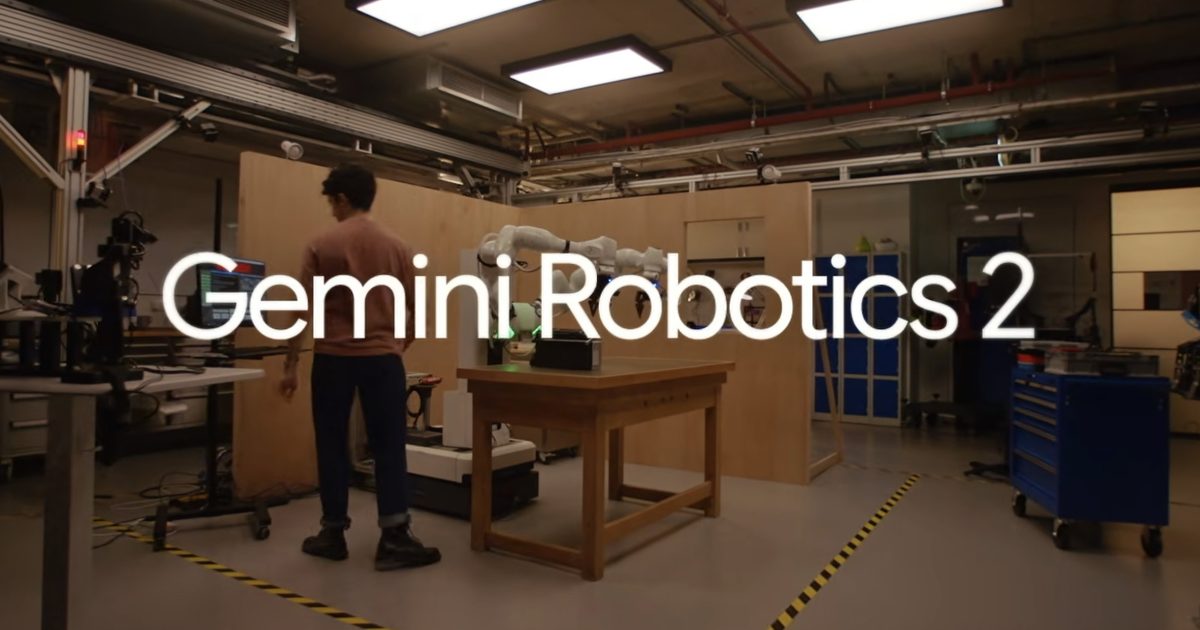
Google DeepMind just brought sci-fi robots closer to reality, and it is very exciting. Building on its original Gemini Robotics model, the company has introduced Gemini Robotics 2, an AI system designed to help robots think, move, and even work together. Unlike most robots today, which rely on pre-programmed routines or someone controlling them remotely, this new system lets robots figure things out on their own when situations get unpredictable.
Can robots finally handle whole-body tasks?
Until now, Google's robotics models mostly handled tabletop tasks using a robot's upper body. Gemini Robotics 2 changes that by controlling the entire humanoid, from its feet all the way to its fingertips. In one demo, Apptronik's Apollo 2 robot was asked to place a watering can into a bin on a bottom shelf. The robot walked over, picked up the can, crossed the room, and set it down exactly where it belonged.
This is a significant leap over previous robotic systems. Traditional industrial robots are often bolted to a factory floor, performing repetitive arm movements. Mobile robots, meanwhile, typically navigate via laser scanners and follow pre-mapped paths. Gemini Robotics 2 represents a move toward adaptive, whole-body intelligence. The robot can now coordinate its locomotion with its manipulation, adjusting its posture and steps in real time. That kind of integration is a major challenge in robotics, requiring simultaneous processing of visual, proprioceptive, and motor data. Google's model handles this with a multimodal language model trained on massive amounts of video and sensor data, enabling the robot to react naturally to its environment.
Dexterity that approaches human hands
The model also brings noticeably better dexterity. It can control a five-fingered robotic hand well enough to tie a knot, seal a zip-lock bag, or unscrew a bulb, and it works just as smoothly with simple two-fingered grippers for tasks like packing and sorting. This is not just a matter of having more degrees of freedom. It requires the AI to understand subtle contact forces, friction, and the behavior of deformable objects. Tying a knot, for example, is easy for a human but notoriously difficult for a robot because the string keeps changing shape and the grip must be adjusted continuously. Gemini Robotics 2 seems to handle these challenges with an impressive level of skill.
Why does dexterity matter so much? Because most real-world tasks, from cooking to warehouse picking to assembling electronics, demand fine motor skills. Two-fingered grippers are sufficient for many simple operations, but they fail when objects are irregular, soft, or fragile. By combining language understanding with tactile feedback, Gemini Robotics 2 can choose the appropriate strategy for each gripper. For a warehouse where items come in varied shapes, the same AI can switch between a precision pinch and a power grasp without explicit reprogramming. This flexibility could make automation far more practical for small and medium-sized businesses.
The reasoning engine: Gemini Robotics ER 2
Alongside this, Google is introducing a reasoning model called Gemini Robotics ER 2, which basically acts as the robot's project manager. It breaks down instructions, keeps track of multi-minute tasks, and can even get multiple robots to coordinate on the same job. For instance, if a human asks a robot to tidy a room, ER 2 will parse the instruction into subtasks: identify objects out of place, classify them, decide where they belong, and then plan a sequence of pick-and-place actions. If two robots are working together, ER 2 can assign roles, avoiding collisions and ensuring that the overall task is completed efficiently.
This reasoning capability represents a shift from perception-and-action to cognition. Earlier robots were essentially reactive: they saw an object and moved toward it. Gemini Robotics ER 2 brings a higher level of planning, almost like the robot is thinking ahead. It can handle instructions that involve conditional steps, such as "if the cup is dirty, wash it before putting it away." That requires common-sense reasoning and the ability to monitor progress over time. The model also recognizes when a task is ambiguous or risky, prompting the robot to ask for clarification instead of blindly proceeding.
The underlying technology is built on Google's multimodal language models, which have been fine-tuned for robotic action. By using a similar architecture to Gemini chatbots, the robot can understand natural language commands and reason about spatial relationships. For example, it can distinguish between "the cup on the left" and "the cup near the sink" based on context. This is far more advanced than traditional robots, which require precise coordinates or pre-defined names for objects.
Fast adaptation to new robot bodies
There's also an on-device version built for robots without internet access, which can adapt to a brand-new robot body in just a few hours using as few as 200 examples. This is crucial for deployment in factories, hospitals, and other places where reliable internet is not guaranteed. The on-device model runs locally, reducing latency and improving privacy. But the most notable aspect is its ability to generalize to different physical configurations. Typical AI models are trained for a specific robot, so transferring them to another platform is expensive and slow. Gemini Robotics ER 2 can quickly learn the kinematics and dynamics of a new robot by observing just a few demonstrations.
This adaptability could accelerate the commercial adoption of humanoid robots. Many companies are experimenting with different designs, from dual-arm mobile robots to full humanoids like Apptronik's Apollo and Figure's 01. With a single AI system that can be fine-tuned for any of them, the need for bespoke software dramatically decreases. That may lower the barrier for small robotics startups and open up new applications in elder care, logistics, and home assistance.
Safety first: the ASIMOV-Agentic benchmark
Safety got real attention this time around. Google introduced a new benchmark, ASIMOV-Agentic, to test whether robots know when to refuse a risky action or ask a human for help instead. The benchmark is named after Isaac Asimov, the science fiction author who proposed the Three Laws of Robotics. As AI systems become more autonomous, it is critical that they not only avoid harming humans but also recognize the limits of their own knowledge. For example, if a robot is asked to pick up a knife from a table, it should recognize the risk of injury and ask the user to confirm the grip point before proceeding. ASIMOV-Agentic consists of simulated scenarios where the robot must decide between acting, seeking clarification, or refusing to execute a command.
Gemini Robotics ER 2 can also sense when someone gets too close and bring the robot to a safe stop. This is a practical feature for collaborative environments where robots work alongside people. Traditional safety systems rely on programmable zones or laser curtains, but these require careful setup. With Gemini Robotics, the robot uses its own perception to monitor distance and velocity, adjusting its motions to avoid collision. The model is designed to prioritize human safety even when the human is moving unpredictably. In the event of close contact, the robot ceases motion instantly, preventing injury. This is essential for gaining public trust in humanoid robots.
The benchmark and safety mechanisms are not just theoretical exercises. Google is placing a strong emphasis on responsible AI development, and these features are likely to be scrutinized by regulators and insurance companies. By publishing the ASIMOV-Agentic benchmark, Google aims to set a standard for the entire robotics industry. Other companies may adopt similar tests, creating a shared baseline for safe autonomous behavior.
Availability and early access
Gemini Robotics ER 2 is already live on Google AI Studio, while the rest of the models are currently rolling out to early access partners. Developers can start experimenting with the reasoning model immediately, testing its ability to parse instructions and plan actions in simulated environments. The full robotics model, including the dexterity and whole-body control features, is being shared with select partners such as Apptronik. This phased rollout allows Google to gather feedback and refine the system before a wider release.
The implications of this technology extend far beyond the lab. Imagine a warehouse where humanoid robots unload trucks, sort packages, and build pallets without constant human supervision. Or a home assistant that can tidy tables, fold laundry, and prepare simple meals. Those scenarios have been promised for decades, but previous robots fell short in real-world complexity. Gemini Robotics 2 is far from perfect, and many challenges remain, such as battery life, mechanical reliability, and cost. However, the AI component is often the hardest part, and Google's progress suggests that the dream of versatile humanoid robots is inching closer to reality.
For now, the technology is limited to a handful of manufacturers and research groups. But Google DeepMind's approach is unique because it leverages the same large-scale models that power its language AI. The company has a history of releasing foundational models that others build upon, and this robotics system could follow a similar trajectory. If the early access program succeeds, we might see Gemini Robotics 2 powering third-party robots by next year. The future of robotics is not just about mechanical strength; it is about intelligence, adaptability, and safety. With Gemini Robotics 2, Google is making a bold statement that those qualities are finally within reach.
Source:Digital Trends News