

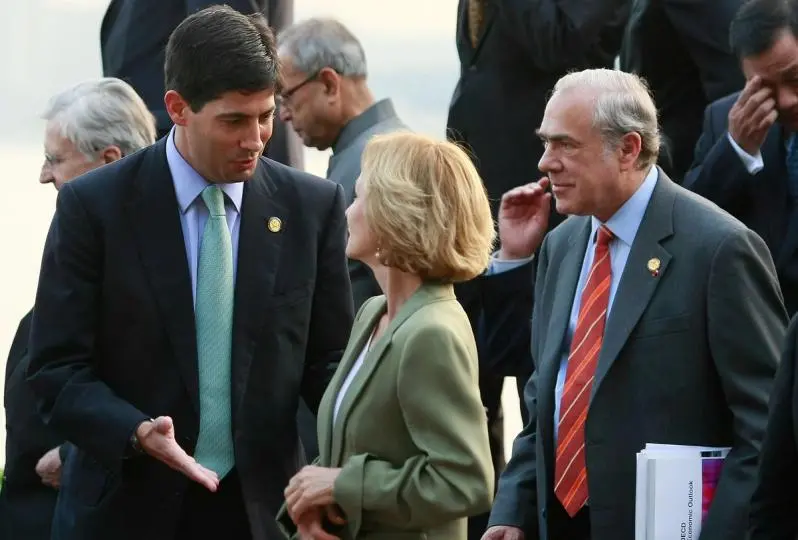
The Federal Reserve concluded its first policy meeting under new Chair Kevin Warsh on Wednesday, leaving the benchmark federal funds rate unchanged at 3.50%-3.75%. The decision was widely expected, but the accompanying statement and press conference revealed a distinctly hawkish turn that roiled financial markets. The central bank removed any reference to a bias toward easing, instead emphasizing its commitment to delivering price stability. The shift caught many investors off guard, as expectations had been building for a more accommodative stance under Warsh's leadership.
Fitch Says Fed's Inflation Fight Remains Intact
Fitch Ratings quickly weighed in, noting that the decision to hold rates steady signals the central bank remains focused on preventing a renewed inflation surge. "The Kevin Warsh era may signal a new leadership chapter, but not a new inflation regime," said Olu Sonola, Fitch's head of U.S. economics. Sonola emphasized that policymakers remain wary after underestimating inflation earlier in the decade and are unlikely to tolerate a similar mistake. While easing tensions in the Middle East could help reduce energy-related price pressures, he warned that inflation risks may be spreading beyond energy markets. "There is early evidence that price pressures may be extending beyond energy," Sonola added. If broader inflation pressures continue to build, the Fed may be forced to tighten policy further, shifting its stance from patience to preemption.
Market Reaction: Bitcoin, Stocks, and Bonds
The immediate market reaction was swift and broad. Bitcoin (BTC) fell about 1% to $65,300 shortly after the decision, though it later recovered to $65,600. The Nasdaq dropped 0.5%, while the S&P 500 also turned lower. The two-year Treasury yield, which is more closely tied to Fed policy, jumped nine basis points to 4.14%, while the 10-year yield rose four basis points to 4.46%. By the close of trading, the Nasdaq and S&P 500 were each down more than 1%, and bitcoin slipped further to $64,600, down 1.6% on the day. The two-year yield had surged a whopping 14 basis points to 4.19% as interest rate traders priced in a 28% chance of a rate hike at the Fed's next meeting in July, up from just 8% prior to the announcement.
Warsh's Press Conference and Task Force Announcement
Leading off his post-meeting press conference, Chair Kevin Warsh acknowledged that inflation remains well above the Fed's 2% goal. "Persistently high prices are a burden to the American people," he said. Warsh announced the creation of a task force to examine reforms in five key areas of monetary policy: Fed communications, the balance sheet, use and reliance on existing data sources, productivity and jobs, and the bank's inflation frameworks. The announcement was seen as an attempt to signal a fresh approach, but markets remained focused on the hawkish tilt. Bitcoin recovered slightly from its knee-jerk reaction, trading at $65,600, down only a hair over the past 24 hours, while the Nasdaq turned positive after earlier declines.
Updated Projections Show Rate Hikes on the Table
The updated Summary of Economic Projections, including the so-called "dot plot," revealed a significant shift. The year-end fed funds rate projection rose to 3.8% from 3.4% three months earlier. Notably, Warsh, who has been a critic of relying on projections, did not submit his own estimate. Of the 18 Fed members who submitted projections, 9 now expect a rate hike in 2026. This hawkish repricing sent shockwaves through rate markets, with CME FedWatch data showing an 80% probability of at least one rate hike by the end of 2026.
Strategy's STRC Plunges to New Lows
Among the biggest losers was Strategy's high-yielding preferred stock STRC, which sank to $89, marking what analysts called the largest "de-peg" ever. The security, pitched by Michael Saylor as akin to a high-yield savings account, was designed to trade near its par value of $100. Instead, it lost 11% in a short period. Peter Schiff commented on the plunge, writing on X: "Risk-averse retirees whom Saylor convinced to buy last month are already down over 10.5%, almost an entire year's 11.5% yield. Worse, to bail them out, Strategy will have to raise the yield to 13%, destroying more common shareholder value." Strategy responded by noting that it has 32 years of STRC dividend coverage through its bitcoin holdings. MSTR common stock closed down 3.5% as bitcoin slid. The hawkish Fed turn added pressure, as higher rates would make STRC less attractive relative to other yield-bearing assets.
SpaceX Faces First Negative Session
Even high-flying SpaceX (SPCX) was not immune to the market selloff. The recently IPO'd stock fell 5.5% shortly before the close, its first negative session. Despite the drop, SpaceX remains up 40% from its IPO price of $135. The broader market rotation out of growth stocks into safer assets weighed on the stock, as the Nasdaq declined 1.35%.
Trump Weighs In
President Trump, speaking to reporters in France at the G7 meeting, said the Fed's decision to hold rates steady seemed acceptable. Regarding the possibility of rate hikes, Trump acknowledged it could happen. The president had spent much of 2025 and early 2026 arguing for rate cuts, even nicknaming then-Chairman Jay Powell "too late." However, Trump appears to have changed his stance as both the economy and inflation continued to grow, now accepting that the Fed's next move may be tighter policy.
Polymarket Restraining Order Denied
In other news, a federal judge in Michigan denied Polymarket US's motion for a temporary restraining order that would block the state from suing the prediction market platform. Judge Paul Maloney ruled that Polymarket did not demonstrate it would succeed on the merits of its broader action. "There is no clear statement that Congress intended to supersede the states' traditional role in regulating gambling," the judge wrote. Polymarket had sued in March to prevent Michigan from taking enforcement action against it.
Analyst Perspectives: Hawkish Fed Amid Falling Oil
Lekker Capital CIO Quinn Thompson noted the irony of the hawkish pivot: "Oil is down 30% since the FOMC's last dot plot was published at the March meeting. Despite that, the committee somehow chooses now is the right time for their hawkish pivot." Thompson suggested that markets might be mispricing the likelihood of rate hikes, but CME FedWatch data showed traders had priced in an 80% chance of one or more hikes by end of 2026. The decline in oil prices, driven by a U.S.-Iran agreement that pushed Brent crude back to around $75 per barrel, is seen as disinflationary, yet the Fed appears more concerned about broader price pressures.
Bitcoin ETF Flows Show Early Recovery Signs
Bitcoin spot ETFs appeared to stem their heavy outflow streak, which had seen more than $5 billion in withdrawals since May 15. Over the past three trading sessions, U.S. ETFs recorded net inflows on two occasions: $10 million on Tuesday and $86 million on Friday, per SoSoValue data. BlackRock's IBIT continued to attract demand, adding $150 million over four consecutive days. However, the sector still recorded $54 million in net outflows for the week, putting it on track for a sixth straight week of withdrawals. The key question is whether the positive flows can be sustained.
On-Chain Signals: Bitcoin Accumulation Underway
Several on-chain metrics pointed to a potential bottom. Bitcoin's RHODL Ratio, which compares wealth held by long-term holders against fresh short-term capital, began rolling over from its peak. This pattern emerged at the 2015 and 2022 cycle bottoms, both of which marked the end of bear markets before major recoveries. The Sharpe ratio, measuring risk-adjusted return, dropped to -20 on June 11, a level that has marked every cycle low since 2015. While this signal typically indicates a floor is forming rather than an immediate rebound, accumulator wallets took in about 125,000 BTC in the first half of June, and exchange reserves fell roughly 80,000 BTC since February to 2.71 million. Whales pulled more than 11,000 bitcoins off exchanges in the past day. The order book on Binance also showed a bullish shift, with the buy-side liquidity imbalance surging to its highest level since at least February 2024, indicating renewed investor demand.
Seasonal Patterns and Market Sentiment
Bitcoin's seasonal weak spot in mid-June has historically marked local bottoms. In 2021, bitcoin fell roughly 50% from April highs amid China's mining ban; in 2022, it plunged to around $17,000 during the collapse of Three Arrows Capital; in 2023, it traded below $25,000; and in 2024, it consolidated around $65,000. In 2025, it hovered near $100,000 before rallying to new all-time highs in July. Anthony Scaramucci, CEO of Skybridge, remains bullish, noting that widespread apathy is often a bullish signal. He expects bitcoin to start rallying in late 2026 and continue into early 2027, emphasizing that depressed RSI levels and thin liquidity mean even modest demand could drive prices sharply higher.
As markets digest the Fed's hawkish turn, the focus now shifts to the July meeting, where rate hike odds have surged. The combination of persistent inflation, a new Fed chair, and geopolitical developments will continue to shape the trajectory of risk assets, including bitcoin and cryptocurrencies.
Source: Coindesk News