

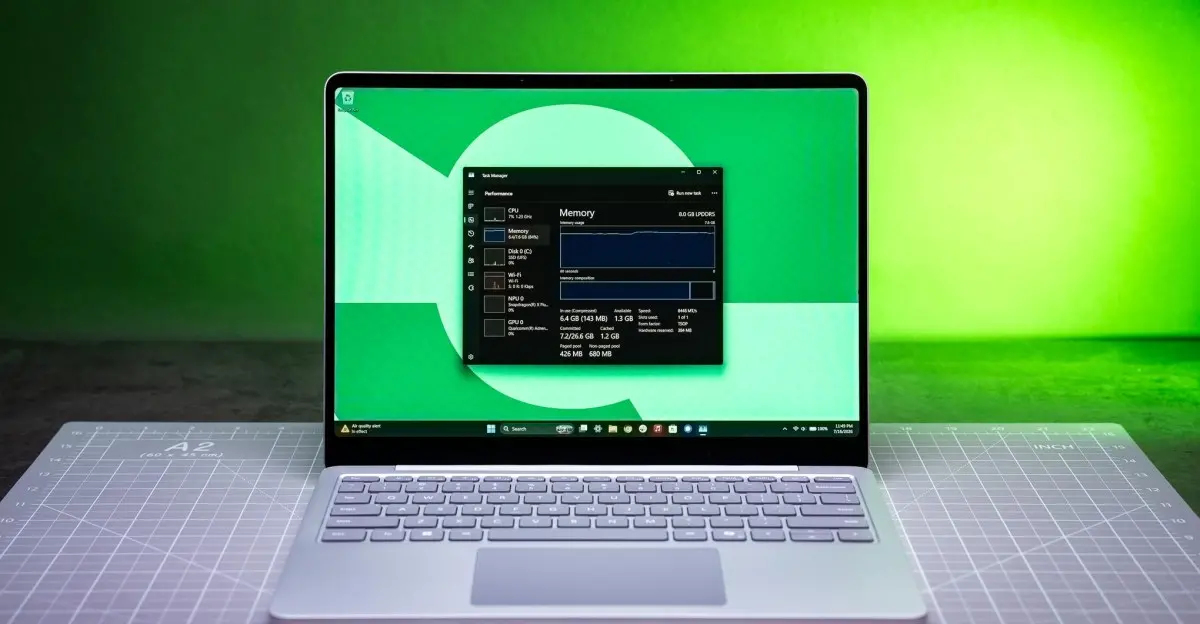
Last year, Microsoft’s 13-inch Surface Laptop was one of the best thin-and-light Windows notebooks you could buy. At $900, it offered a great keyboard, excellent trackpad, long battery life, and a sleek design that rivaled the MacBook Air. I even recommended it to family members. But in 2026, the same laptop—now priced at $950—comes with half the memory: just 8GB of RAM. It’s the same beautiful hardware on the outside, but the experience inside has taken a significant hit.
This is the result of what industry insiders are calling “RAMageddon”—a global shortage of memory chips driven by skyrocketing demand for AI hardware, data centers, and consumer devices. Microsoft, like many PC makers, is feeling the pinch. To keep entry-level prices from skyrocketing, they’ve cut RAM back to 8GB, a specification many thought had been left behind years ago. But the crucial question is: can Windows 11 even run well on 8GB in 2026? After testing the 2026 Surface Laptop, the answer is a definitive no.
The Hardware Is Still Great—But Memory Matters More
Let’s be clear: the hardware itself is nearly identical to last year’s model. The 13-inch touchscreen (1920 x 1280, 60Hz) is sharp and vibrant, the keyboard is tactile and comfortable, and the glass trackpad is one of the best on Windows—only outdone by those that click corner-to-corner. The processor is an eight-core Qualcomm Snapdragon X Plus (X1P-46-100), which is essentially the same as last year’s chip with a slightly higher boost speed. This CPU performed admirably in 2025 with 16GB of RAM. But memory is the bottleneck that brings the whole system to its knees.
Windows 11 itself consumes about 4.2GB of RAM at idle after a fresh boot with minimal startup programs. That leaves less than 4GB for everything else. In real-world use, with just 10 Chrome tabs across two virtual desktops, along with Slack and Signal running in the background, the system hovered around 6.7GB of usage out of 7.6GB available. That’s dangerously close to capacity. The result? Frequent hangs and stutters—especially when something unexpected happens, like a video starting to play during a Microsoft Teams call. Even without demanding tasks, the laptop would freeze for several seconds multiple times a day.
The problem is not just about peak performance; it’s about headroom. With 8GB, Windows 11 constantly has to swap memory to the SSD, which, even on a fast PCIe drive, introduces noticeable latency. The Surface Laptop uses UFS storage instead of a faster NVMe SSD, which makes things worse. The constant swapping degrades the user experience over time and reduces the lifespan of the storage.
Why 8GB Wasn’t Good Enough—Even for Microsoft
For years, tech reviewers—including those at The Verge—have warned that 8GB is no longer sufficient for a primary Windows PC. But Microsoft itself had begun shipping 16GB as the standard in its Surface Laptop lineup. This regression is a stark reminder that operating systems and applications have grown hungrier. Chrome alone can easily consume 1GB to 2GB with a dozen tabs. Microsoft Teams, Slack, and Signal together can eat another 1GB. And Windows 11’s background services—Windows Defender, OneDrive syncing, widgets, and telemetry—all add to the load.
In my testing, I deliberately tried to “manage” memory by keeping only six Chrome tabs open and closing all background apps. Memory usage dropped to about 5.5GB, which felt smoother. But at $950, no user should be forced to micromanage their workflow to keep the machine from freezing. The laptop is intended to be an everyday device for students, professionals, and casual users. If it can’t handle a simple video call while you have a few tabs and messaging apps open, what’s the point of the premium build quality?
The irony is thick: Microsoft is the company that makes Windows 11 and also one of the major players in the global RAM shortage (through its massive investments in AI infrastructure). If even Microsoft can’t make its own operating system run smoothly on 8GB, what hope do other OEMs have? This is not a problem that can be solved by better drivers or optimizations—the fundamental memory requirement of modern Windows 11 is simply too high for 8GB to be a comfortable baseline.
Comparing to MacBook Neo and Other Rivals
Apple’s MacBook Neo also starts at $699 with 8GB of unified memory, but macOS handles memory more efficiently. In my experience, the Neo could handle more multitasking without the same level of stuttering—partly because its M-series architecture uses a unified memory pool that reduces latency, and partly because macOS has a more aggressive memory compression system. Even so, Apple has faced criticism for offering only 8GB in 2026, but at least the experience is smoother than what Microsoft delivers. The Surface Laptop costs $250 more and performs worse—a tough sell.
Other Windows laptops with 8GB are on the horizon. At Computex 2026, Dell, Acer, and Asus all announced entry-level models with 8GB of RAM. If Microsoft’s flagship can’t tame the memory beast, budget laptops from these manufacturers will likely suffer even more, especially if they use slower RAM or less efficient processors. The days of “8GB is enough for web browsing and email” are long gone.
The RAM Crisis and Market Implications
The RAM shortage has been building for over a year. Prices for DRAM and NAND flash have tripled in some cases, driven by demand from AI training, data centers, and automotive systems. PC makers are forced to choose between higher prices or lower specs. Many are choosing the latter, offering 8GB or even 4GB in some ultra-budget models. But this is a short-sighted solution that will damage the Windows ecosystem in the long run.
Microsoft has publicly stated its focus for 2026 is to improve Windows 11 performance and reliability—especially for lower-cost hardware—to compete with Google’s ChromeOS and Apple’s Mac lineup. But actions speak louder than words. The Surface Laptop with 8GB is a step backward. It’s possible that Microsoft could release a “Windows 11 Lite” or a special edition for low-RAM devices, but no such announcement has been made. Until then, consumers are stuck choosing between performance and price.
What Should Buyers Do?
If you’re in the market for a new laptop in 2026, the simplest advice is to avoid any Windows machine with 8GB of RAM. Look for 16GB as the minimum, even if it costs more. The Surface Laptop itself is available in a 16GB configuration for $1,150, which brings back the excellent experience from last year. Other manufacturers still offer decent sales on 16GB models. Refurbished or open-box units from reputable sources are also a good option. Alternatively, consider the MacBook Neo if you’re willing to switch ecosystems, or wait for prices to stabilize—though that may take years.
The 8GB Surface Laptop is a cautionary tale. It proves that great hardware cannot compensate for insufficient memory. Microsoft’s own inability to make Windows 11 run well on its flagship device should be a wake-up call. The RAM shortage is not going away soon, and the industry may face a new normal where 8GB is considered “entry-level” once again. But that doesn’t mean users have to accept a subpar experience. Spend a little more now to get a machine that will last five years, and you’ll thank yourself later.
Benchmark Insights
In synthetic benchmarks, the 8GB Surface Laptop performed respectably on CPU tests, matching last year’s 16GB model in single-core Geekbench 6 scores (2,348 vs 2,437). But multi-core scores were slightly lower (9,421 vs 11,428), likely due to memory bandwidth limitations. The biggest difference came in real-world creative tasks: PugetBench for Photoshop scored 2,887 on the 8GB model versus 4,773 on the 16GB model. Video editing in Premiere Pro crashed entirely on the 8GB machine. These results confirm that while the processor is capable, the memory ceiling is the real bottleneck.
Storage speeds also took a hit. Sustained reads on the 8GB model were 3,804 MB/s versus 3,840 MB/s on last year’s model, but writes were slightly faster (3,310 vs 3,476). However, the smaller 256GB capacity means users will fill it quickly, especially with modern apps and files. An upgrade to 512GB would cost extra, but even then, the memory limitation remains.
The 8GB Surface Laptop is a paradox: it looks and feels premium, but it cannot deliver a premium experience. Microsoft has proven that even the best hardware design cannot overcome a fundamental lack of memory. For a company that prides itself on productivity, this is a disappointing misstep. As the RAM crisis deepens, buyers must vote with their wallets—and choose 16GB or more.
Source:The Verge News