

Google Opens Play Store to Vibe-Coded Apps
Google has announced a major set of updates to the Play Store that will allow anyone who vibe codes an Android app to distribute it through the marketplace with only a Google account. The change is part of a broader overhaul of publishing, recommendations, and gaming features on Android. While the Play Store has evolved significantly in recent years, both because of Google's push to embed artificial intelligence into its products and because of legal pressure to open the store to competitors, this publishing shift could prove to be one of the most consequential.
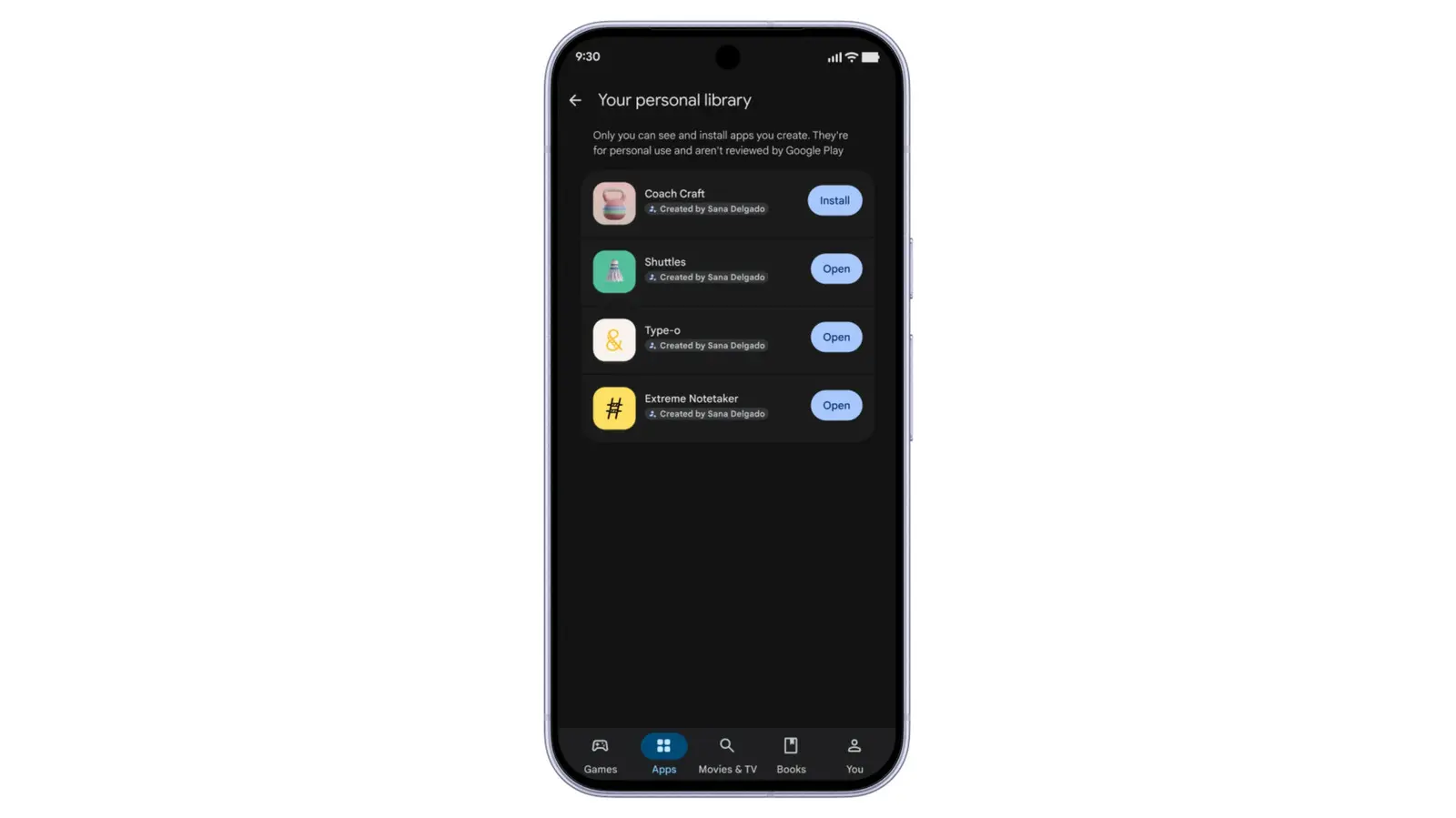
For years, Android users have been able to sideload APK files onto their phones and tablets, installing software outside of the official Play Store. Google has made that process more complicated over the past year, adding warnings and friction designed to protect users from malware and scams. The new publishing process promises to make distribution easier for a specific category of apps: those generated with AI assistance, often called vibe-coded apps. Rolling out to users in the United States and other select markets who are 18 years and older, the system will let people upload a vibe-coded Android app from Google AI Studio without needing a paid developer account.
Google AI Studio is the company's browser-based environment for experimenting with Gemini, its family of large language models. It can generate functional apps from a written prompt, and users can refine the results with additional prompts or by directly editing the generated code. That means someone with an idea but limited programming experience can create a simple app, test it, and now publish it to their own devices with far less overhead than the traditional developer path requires.
Personal Library First, Professional Publishing Later
At launch, a vibe-coded app will only be available on the creator's own devices, including tablets and computers that have access to the Play Store. It will appear in a new section called a personal library. This approach gives creators a private testing ground before they expose their work to a wider audience. Google eventually plans to let users securely share their vibe-coded apps with friends and family, turning the personal library into a small distribution network for trusted contacts.
When a creator wants to distribute an app to a global audience, Google says it will be possible to graduate to a professional developer account and submit the app to the Play Store's normal safety reviews. That step preserves the existing layer of scrutiny for public releases while lowering the barrier to entry for personal and small-scale projects. The distinction matters because it separates experimentation from mass distribution, allowing Google to balance openness with security.
The move also reflects a changing app economy. Traditional app development often requires knowledge of languages like Kotlin or Java, an understanding of Android's APIs, and a paid developer account. Vibe coding, by contrast, emphasizes natural language prompts and iterative refinement. It has become a popular approach for prototypes, internal tools, educational projects, and novelty apps. By integrating this workflow into the Play Store, Google is acknowledging that AI-assisted creation is not a fringe activity but a growing part of how software gets made.
AI-Powered Discovery Comes to Gemini and Live Sports
Alongside the publishing changes, Google is making tweaks to app discovery and its expanding list of gaming-focused features. The company already introduced its biggest discovery change, Ask Play, at its I/O 2026 developer conference. Now it is bringing similar capabilities to Gemini by allowing the AI assistant to surface direct links to Play Store apps during chats. A user who asks Gemini for a recommendation could receive a direct path to install a relevant app without leaving the conversation.
Google is also expanding its sports topic pages, which appear in the Play Store during live matches. These pages will now cover soccer games from the Premier League, Major League Soccer, and other competitions. The goal is to meet users at moments of high engagement, when they are already thinking about a sport and may be open to discovering related apps, games, or content. In cars with Google built-in and on Android XR, the company is updating the Play Store layout to better fit the size of a physical or virtual screen. That includes adjustments for dashboard displays and extended reality headsets, where traditional phone interfaces may not work as well.
These discovery updates point to a broader shift in how app stores operate. Instead of relying solely on search bars and curated lists, Google is trying to use AI assistants, live events, and context-aware surfaces to put apps in front of users. If successful, that could help smaller developers find audiences without spending heavily on advertising. It could also raise questions about how recommendations are ranked, how sponsored placements are disclosed, and whether AI assistants favor Google's own services over competitors.
Game Finder, Gamer DNA, and New Social Tools
For users who are specifically interested in finding games, Google is introducing a Game Finder feature that can recommend titles based on individual taste. The recommendations are powered by what Google calls Gamer DNA, a new taste profile that users can finetune with their preferences and favorite genres. During a roundtable with press, Google suggested it hopes to make filters and genre tags increasingly granular. That could eventually let players search for games that offer controller support, for example, or drill down into very specific subgenres and play styles.
Google is also adding game playlists, a feature that lets users recommend a collection of mobile games for other people to try. Think of it as a curated mixtape, but for games. A player could assemble a list of favorite puzzle games, multiplayer shooters, or indie gems and share it with friends. The feature could help discovery become more social, relying on trusted recommendations rather than algorithmic suggestions alone.
The company is updating the overall experience of playing games on Android as well. Its Sidekick overlay has a new feature that allows it to record 30-second clips of gameplay. Those clips can be shared, turning ordinary play sessions into short highlights. Developers are also receiving a collection of new tools intended to increase engagement. These include Sprints, Community Posts, and an expansion of the Quests feature.
Sprints are 48-hour in-game challenges that match players with others of a similar skill level to compete for the highest score. They add a time-limited competitive layer that can bring lapsed players back and give dedicated players a reason to keep playing. Quests, which previously allowed developers to reward players with Play Points, now also lets them provide in-game rewards. That makes the incentive more immediate and more closely tied to the game itself. Finally, Community Posts adds a Q&A section to store pages so players can ask and answer questions about games directly in the Play Store. That could reduce reliance on external forums and social media for basic troubleshooting and recommendations.
Why the Change Matters
The helpfulness of these new features depends heavily on how much users trust AI's ability to build apps and offer recommendations. AI-generated code can contain bugs, security flaws, or unintended behavior. Vibe-coded apps may be simple and personal, but once they are shared or published, they can pose risks. Google's decision to keep personal library apps on a user's own devices at first, and to require a professional developer account for global distribution, is a way to manage those risks without closing the door on experimentation.
The broader context is competitive and legal. Google has faced antitrust scrutiny over the Play Store, including cases and regulations that challenge its control over app distribution and payments. In some markets, regulators have required changes that make it easier for third-party app stores and alternative billing systems to operate. At the same time, third-party app stores can now be installed through the Play Store in some contexts, increasing competition for developers and users. Google's new features, from AI-assisted publishing to improved discovery and gaming tools, are a sign that it wants to keep the Play Store attractive and relevant in a world where app distribution is no longer a guaranteed monopoly.
For developers, the changes could lower the cost of launching an idea. A hobbyist can generate an app, test it privately, share it with family, and later decide whether to pursue a professional release. For users, the Play Store may become more personalized and more social, with AI assistants, game playlists, and community Q&A shaping what they find. For Google, the challenge will be maintaining trust and safety while opening the gates to a new wave of AI-generated software.
Source:Engadget News