

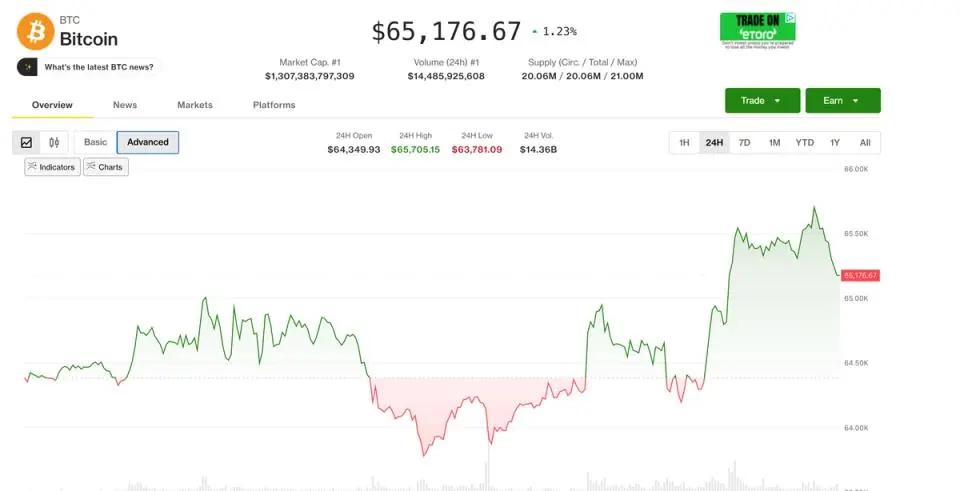
Bitcoin climbed to a one-month high of $65,700 early Monday before retreating to around $65,000 as risk assets sold off in the afternoon. The intraday reversal mirrored a broader pullback in U.S. equities, with the Nasdaq closing roughly flat after being up more than 1% earlier, and the S&P 500 and Dow Jones Industrial Average falling 0.15% and 0.6%, respectively.
The initial rally came after a Reuters report that Iran was seeking a 10-day ceasefire to revive talks with the U.S., sending WTI crude oil down about $3 per barrel to below $80. However, the report quickly lost traction, and oil prices rebounded to around $82.50, near one-month highs. At the same time, the 10-year U.S. Treasury yield rose five basis points to 4.59%, while CME FedWatch data showed traders pricing in 16% odds of a July rate hike and 63% odds of a September rate hike. These factors weighed on risk assets, including bitcoin, which gave up most of its gains by the close.
Market Context and Bitcoin's Struggles
Bitcoin has tested and failed at the $65,000 level multiple times since the June crash that dragged prices as low as $58,000. The inability to decisively break above that resistance highlights the lingering fragility in the crypto market, despite a generally positive backdrop for risk assets over the past month. The broader crypto market saw modest gains on Monday, with ether, XRP, and solana all up about 1.4% alongside bitcoin. However, the pullback in late trading suggests that macro headwinds remain a significant challenge.
Geopolitical tensions between the U.S. and Iran continued to drive oil prices higher, reigniting inflation concerns that had been tempered by softer U.S. economic data earlier in the month. Brent crude briefly topped $90 a barrel as U.S.-Iran strikes widened. This uncertainty forced investors to reassess the likelihood of further Federal Reserve tightening, which in turn pressured equities and cryptocurrencies.
Crypto Stocks: IREN and Hut 8 Surge on Major Deals
In the publicly traded crypto space, two stocks stood out on Monday with significant gains. IREN shares rocketed 21% to $40.70 after the company announced new cloud services contracts valued at $2.8 billion. Cantor Fitzgerald reiterated a $99 price target on the stock, citing IREN's access to substantial power and compute resources, as well as its expanding customer base. Despite the gains, IREN remains well off its May highs near $70.
Hut 8 also had a strong day, rising 16.7% after signing a second 15-year lease at its Beacon Point campus in Texas, doubling the existing tenant's capacity to 704 MW and roughly doubling the contract value to $19.6 billion. The deals underscore the growing demand for data center infrastructure to support artificial intelligence and cloud computing, even as the broader AI trade has come under pressure recently.
Other crypto-related stocks also posted gains. Galaxy Digital rose 8%, Circle climbed 9.5%, BitGo gained 7%, and Coinbase and Figure each advanced about 4%. However, not all enjoyed the rally. Securitize, the tokenization firm backed by BlackRock, slid another 8% to around $6.60, extending its post-listing slump to roughly 50% from its high after going public via a merger with a Cantor-backed SPAC in late June. The company's underperformance stood out against the broader advance, following a pattern seen with other newly listed crypto firms that struggle to hold their early gains.
Strategy Strengthens Cash Reserve, Adds No Bitcoin
Michael Saylor's Strategy, which holds 843,775 bitcoin valued at approximately $54.3 billion, sold $263.5 million in common stock last week, adding $225 million to its cash reserve for paying dividends on its high-yielding preferred stock. The current cash reserve stands at $3.225 billion, equivalent to 22 months of dividend coverage. This marked the second consecutive week Strategy did not buy any bitcoin, instead using capital raising proceeds to boost liquidity. The company's STRC preferred shares rose 2% to $87, offering an implied yield of nearly 14%. Meanwhile, Strategy's common stock (MSTR) gained 1.1% pre-market but gave back some of those gains during the session.
Other corporate bitcoin holders also reported activity. Matt Cole's Strive added 21 bitcoin last week, bringing its total to 19,921 coins, following the sale of 443,797 shares of common stock that raised about $4.5 million. The company's cash reserve increased to $157.4 million. Bitmine Immersion, led by Chairman Tom Lee, added just 7,430 ether tokens — its smallest weekly purchase this year — and repurchased 5.5 million shares of its struggling stock. Bitmine now holds 4.8% of the total ether supply.
Regulatory and Corporate Developments
In a notable move, crypto exchange OKX appointed former New York Governor Andrew M. Cuomo to its Board of Directors. Cuomo had been advising the company since 2023 on U.S. regulatory and institutional strategy. The appointment comes as OKX expands its U.S. presence and moves beyond crypto trading into financial infrastructure. Cuomo also co-chairs the recently announced joint venture between OKX and Intercontinental Exchange (ICE) that aims to connect traditional and digital financial markets through regulated blockchain infrastructure, pending regulatory approvals.
The broader crypto regulatory landscape remains in flux. The Clarity Act, which would provide a framework for stablecoin regulation, is expected to miss its window before Congress' summer break, according to leadership. Meanwhile, the SEC settled with Coinbase over missing text messages from former Chair Gary Gensler, and Robinhood CEO Vlad Tenev's X account was hacked to promote a token amid the memecoin frenzy.
On the technology front, Uniswap pushed deeper into tokenized assets with permissioned trading pools, while Tassat aims to help smaller banks tap the stablecoin boom before Wall Street locks them out. Coinbase's corporate customers can now accept payments from AI agents, highlighting the growing intersection of crypto and artificial intelligence.
Market Outlook: AI Selloff and Geopolitical Risks
The recent rout in chip stocks, triggered by the Chinese AI shock that hit markets on Friday, continued to weigh on sentiment Monday, though U.S. futures pointed higher. The iShares Semiconductor ETF edged up in premarket trading after last week's selloff, setting up a decisive week with major earnings from Alphabet, Tesla, and Intel. Traders will scrutinize these results for signs that the AI spending boom that has powered this year's rally remains intact, or whether last week's volatility has further to run.
Bitcoin's price action remains tied to the broader macro environment, with any escalation in geopolitical tensions or shifts in Fed policy likely to drive near-term volatility. As of the close on Monday, bitcoin was hovering around $65,000, with traders eyeing the next resistance level at $66,000. The ability to hold above $65,000 will be critical for the next leg higher, while a breakdown below $64,000 could signal renewed weakness.
Smaller tokens outperformed on Monday, with Pump.fun's PUMP token gaining over 16%, Pi Network's PI adding 12%, and tokens like JUP, ING, and BEAT each rising 2-3%. On the downside, Provenance Blockchain's HASH token fell nearly 10%, while ZEC, NIGHT, and LIT slipped 3-5%.
Source:Coindesk News