

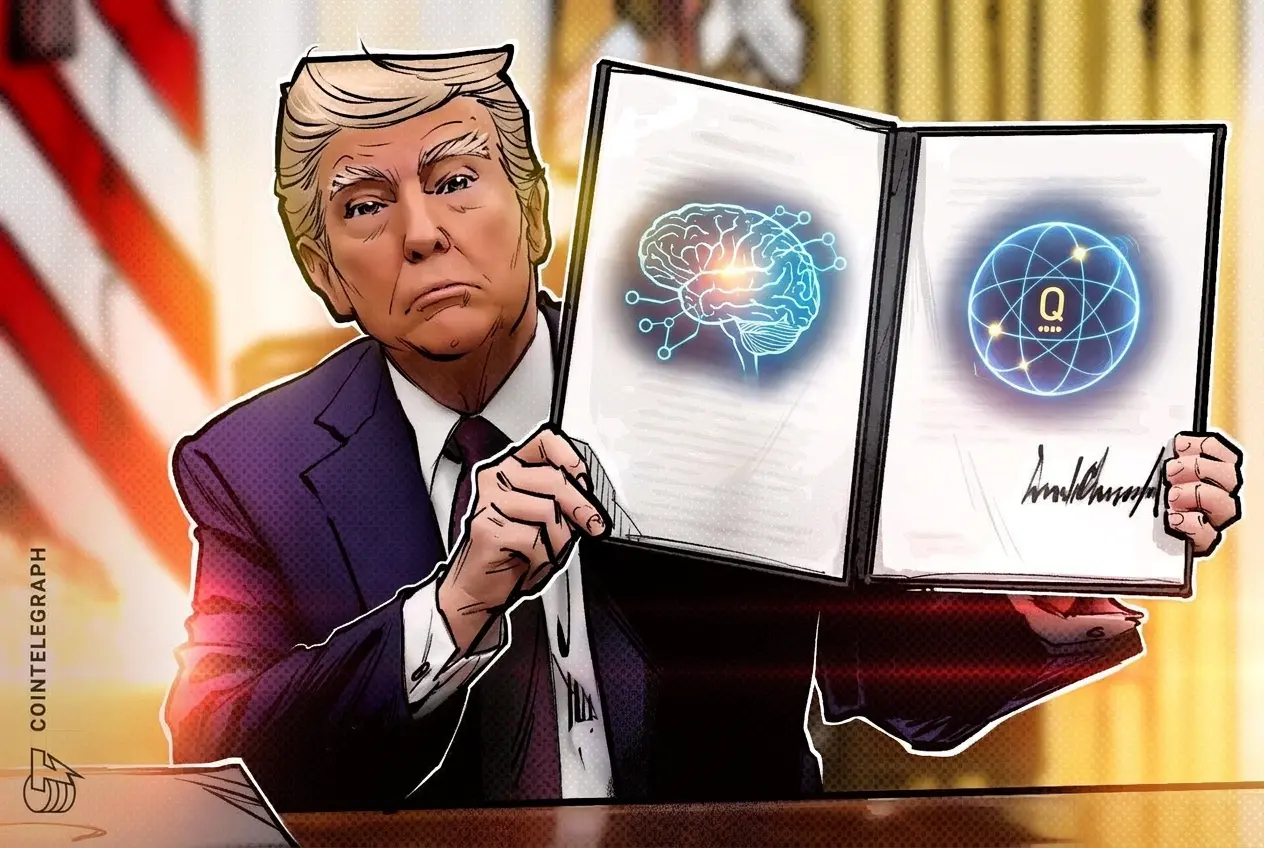
The White House has outlined more than $6 billion in science and technology initiatives, pairing a new quantum computing competition with a set of large industry commitments for artificial intelligence research. The announcements place two of the most closely watched fields in advanced technology at the center of the administration’s science agenda and signal that federal agencies intend to use public funding and private-sector partnerships to accelerate work on both fronts.
The quantum component is being led by the Department of Energy, which identified eight scientific applications to guide its Quantum Genesis Q Competition. The program offers up to $215 million in planned funding to companies developing fault-tolerant quantum computers. First announced in September, the competition is structured around milestone-based awards and incentive prizes for firms that can demonstrate increasingly powerful quantum systems. The research priorities listed by the department span chemistry, materials science, subatomic physics and applied mathematics.
The focus on fault tolerance is significant. Many of today’s quantum processors are experimental systems that remain highly sensitive to noise and error. A fault-tolerant quantum computer would be able to correct errors during calculations and sustain reliable operations at scale, a threshold that researchers have pursued for years but have not yet reached. By tying funding to milestones, the Department of Energy is attempting to measure progress in concrete stages rather than backing a single design or company outright. The competition also uses incentive prizes, a structure that can reward demonstrated technical achievements while spreading support across multiple approaches.
The eight application areas suggest that the government is interested in quantum computing not only as a general-purpose technology but as a tool for specific scientific problems. Chemistry and materials science, for example, are often cited as areas where quantum simulation could help researchers study molecular interactions and design new compounds. Subatomic physics could benefit from quantum systems capable of modeling complex quantum phenomena, while applied mathematics underpins the algorithms and error-correction techniques needed to make quantum machines useful. The competition’s structure therefore links hardware development to practical scientific use cases, rather than treating quantum computing as a standalone race for raw qubit counts.
Quantum computing has also become a subject of concern for the digital-asset industry because of its potential effect on cryptography. Blockchain-based assets rely heavily on public-key cryptography to prove ownership and authorize transactions. A sufficiently powerful fault-tolerant quantum computer could, in theory, derive private keys from exposed public keys, allowing an attacker to steal funds. That scenario remains theoretical: no quantum computer capable of carrying out such attacks currently exists. But the possibility has prompted regulators and technology firms to examine how quickly vulnerable systems might need to migrate to post-quantum cryptography.
On Sept. 23, three European financial watchdogs warned that the development of more powerful quantum computers could undermine cryptographic systems used to secure blockchains and financial transactions. The warning reflected a broader concern among regulators that financial infrastructure built on existing public-key standards may need to be updated well before large-scale quantum machines become available. For crypto assets, the risk is often described in terms of exposed public keys. In many blockchain transactions, a public key becomes visible when funds are spent or when certain address types are used, creating a potential target for a future quantum attacker. The practical danger depends on the size and reliability of the quantum computer, the cryptographic scheme used and whether users have moved assets to quantum-resistant addresses.
The White House’s quantum funding announcement did not propose specific rules for crypto assets, nor did it set a deadline for migrating blockchains to new cryptographic standards. Instead, it framed quantum research as a scientific priority with potential national and economic implications. That approach mirrors a wider policy debate: governments want to encourage quantum innovation while also preparing for the security consequences of the technology. The same advances that could unlock new materials, medicines and computing capabilities could also weaken cryptographic protections that are widely used today.
The AI portion of the announcement is more immediately commercial. The White House said 11 technology companies pledged $2.4 billion in AI tools and compute credits to support research at 15 federal agencies. The commitments include $1 billion from Nvidia, $500 million from AMD, $200 million from OpenAI and $150 million each from Anthropic and Google. The contributions are described as tools and compute credits rather than direct appropriations, meaning their impact will depend on how agencies use the resources and how the commitments are structured.
Compute credits are particularly important in AI research because access to advanced chips and cloud infrastructure can be a limiting factor for public-sector projects. Federal agencies are exploring AI for tasks ranging from scientific modeling and data analysis to administrative efficiency and cybersecurity. The pledged resources could give government researchers access to hardware and software that might otherwise be expensive or difficult to procure. At the same time, the arrangement raises questions about oversight, procurement rules and the influence of private companies over public research priorities. Those questions are likely to follow the program as agencies begin to draw on the pledged tools and credits.
The combined $6 billion figure covers a broader set of science initiatives beyond the quantum competition and the AI commitments. The two elements disclosed in detail show how the administration is trying to blend long-term research funding with shorter-term industry partnerships. The quantum competition is designed to support companies over multiple stages as they work toward fault-tolerant systems, while the AI pledges are intended to provide immediate resources to federal agencies. The strategy reflects a view that government can help accelerate emerging technologies by funding high-risk research and by connecting agencies with private-sector capabilities.
The quantum competition also arrives amid a global race to develop advanced computing. Governments in Europe, Asia and North America have launched their own quantum programs, and private investors have poured money into startups working on hardware, software and error correction. The United States has longstanding research programs in quantum information science, but the new competition adds a milestone-driven funding mechanism aimed at companies rather than only academic laboratories. That distinction could matter for commercialization, because companies must show progress toward practical systems to receive awards.
For the crypto industry, the policy signal is mixed. On one hand, federal support for quantum research could speed the development of tools that make blockchains more resilient, including post-quantum cryptographic signatures and migration pathways. On the other hand, the same research could bring closer the day when existing public-key cryptography becomes vulnerable. Crypto developers have been experimenting with quantum-resistant algorithms and signature schemes, but adoption remains limited. Upgrading a blockchain is not a simple software patch: it can require coordination among validators, wallet providers, exchanges and users, and older addresses may remain exposed if their public keys are already visible on-chain.
Financial regulators have begun to treat quantum risk as part of operational resilience. The European watchdogs’ warning emphasized that cryptographic systems protecting blockchains and financial transactions could be undermined by future quantum computers. That language places quantum risk alongside more familiar cybersecurity threats, even though the timeline for a cryptographically relevant quantum computer remains uncertain. The uncertainty is part of the challenge: preparing for a threat that may be years or decades away requires long-term investment, but delaying preparation could leave systems exposed if advances arrive faster than expected.
The AI commitments may also affect the quantum field indirectly. Machine learning is already used in quantum research for tasks such as calibrating hardware, analyzing experimental data and designing circuits. Greater access to AI compute could help federal researchers test new approaches and collaborate with industry teams. The administration’s decision to announce the quantum and AI initiatives together suggests that it sees the two fields as connected parts of a broader science and technology strategy, rather than isolated programs.
Still, the announcements leave several details unresolved. The White House did not specify how the full $6 billion will be allocated across programs, how quickly the quantum awards will be distributed or how the AI pledges will be governed. The Department of Energy’s competition is described as offering up to $215 million in planned funding, a figure that may depend on appropriations and the number of qualifying projects. The industry AI commitments are pledges of tools and credits, not guaranteed cash, and their value will depend on the terms attached to them.
The quantum competition’s research priorities offer one of the clearest signals of the administration’s technical focus. Chemistry and materials science could support the discovery of new drugs, catalysts and energy materials. Subatomic physics could advance understanding of fundamental particles and forces. Applied mathematics could improve the algorithms that quantum computers will run and the error-correction methods they will need. By naming these areas, the Department of Energy is inviting companies to propose systems that can address specific scientific challenges, not just demonstrate abstract computing power.
That milestone-based approach may also shape how investors and researchers evaluate progress in quantum computing. The field has seen repeated claims of quantum advantage, where a quantum system outperforms a classical computer on a narrowly defined task. Fault-tolerant computing is a more demanding goal because it requires reliable error correction and scalable control systems. Awards tied to milestones could provide clearer benchmarks for judging whether a company is moving toward that goal or merely optimizing a laboratory demonstration.
The crypto security debate is likely to continue regardless of the funding timeline. Blockchain networks that rely on elliptic-curve signatures will eventually need migration plans if quantum computing reaches the scale required to break those signatures. Some projects are researching post-quantum signature schemes, while others are exploring ways to reduce the exposure of public keys. The European watchdogs’ warning added urgency to those discussions, even as researchers caution that no known quantum machine can currently perform the attacks. The gap between theoretical risk and practical capability is where policy, standards and engineering work will have to meet.
The administration’s announcements do not specify a timeline for when fault-tolerant quantum systems might be available, and no such machine is known to exist. The $215 million competition, the $2.4 billion in AI pledges and the broader $6 billion science push together represent a bet that coordinated public funding and private partnerships can accelerate progress in fields with major economic and security implications. For now, the most concrete elements are the funding structure, the named research priorities and the list of corporate commitments.
Source:Cointelegraph News